About This Game
What Is TriMerge
TriMerge is a captivating sliding tile puzzle game that combines arithmetic logic, spatial foresight, and tactical board control. Played on a compact grid, the game challenges players to slide tiles across the board, fuse base numbers, and continuously double higher values to reach impressive score milestones.
While inspired by classic sliding puzzles, TriMerge distinguishes itself through its unique base fusion rule—where numbers 1 and 2 combine to form 3—before transitioning into exponential matching mechanics. With no timer to rush your decisions, TriMerge offers an intellectually rewarding experience that turns simple directional swipes into a rich game of strategic positioning.
How to Play TriMerge
Learning the basic moves in TriMerge takes seconds, but mastering board space requires calculated planning:
- Slide the Board: Use arrow keys, W/A/S/D keys, or mobile swipe gestures to shift all tiles across the grid simultaneously.
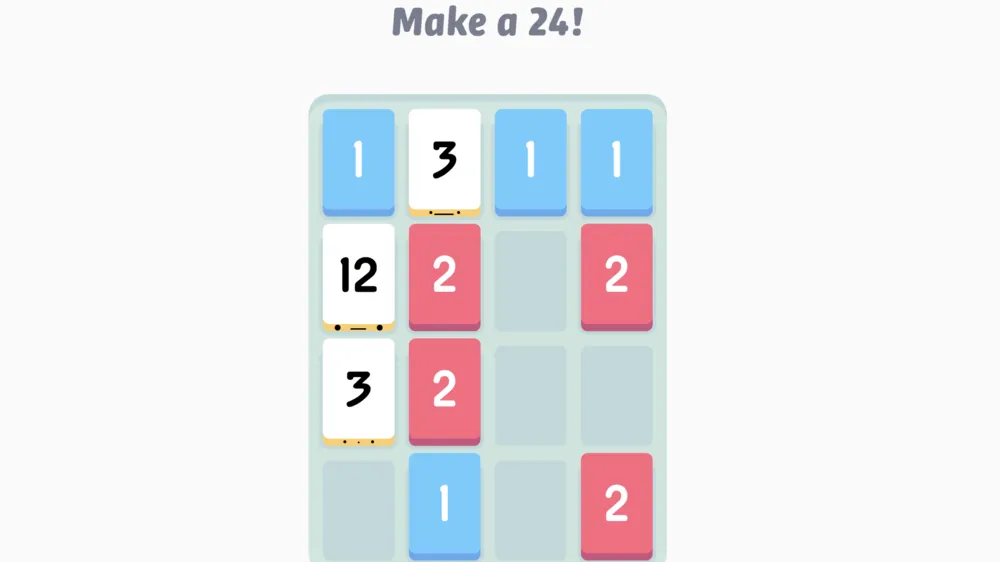
- Combine Base Tiles (1 + 2 = 3): Unlike standard equal-number matching, 1 and 2 are complementary base tiles. Merging a 1 with a 2 creates a single 3 tile.
- Merge Matching Tiles: From 3 onwards, tiles only fuse with identical values. Shift matching tiles into each other to double their value (e.g., 3 + 3 = 6, 6 + 6 = 12, 12 + 12 = 24, 24 + 24 = 48).
- Manage New Tile Spawns: Every slide introduces a new tile onto the board along the edge opposite to your movement direction.
- Survive and Score: The game continues until all grid slots are filled and no adjacent tiles can be legally merged. Plan every move carefully to prevent sudden gridlock.
Key Features & Highlights
- Unique Base Fusion Mechanics: Enjoy a fresh puzzle dynamic where 1 and 2 must be combined before doubling larger numbers.
- Unhurried Strategic Gameplay: Play at your own pace with zero timers or countdown pressures.
- Instant Browser Access: Enjoy seamless gameplay on desktop, tablet, or smartphone without app downloads or account sign-ups.
- Clean Visual Design: Color-coded tiles and crisp numeric styling make calculating future moves fast and intuitive.
- High-Score Replayability: Endless board possibilities encourage endless retries as you refine your cornering and chaining tactics.
Tips & Strategies for High Scores
- Lock Your High Value Tile in a Corner: Choose one corner of the board (e.g., bottom-right) and keep your highest-value tile anchored there. This prevents high numbers from getting trapped behind lower values.
- Stick to Three Primary Directions: Focus your moves on three directional inputs (such as Down, Right, and Left) while avoiding the fourth. Moving away from your anchor corner risks scattering loose 1s and 2s into critical spaces.
- Pair Up 1s and 2s Swiftly: Isolated 1s and 2s are the primary cause of early gridlock. Combine complementary 1 and 2 tiles as soon as they appear to convert them into mergeable 3s.
- Create Cascading Combo Chains: Arrange tiles in descending value order along board edges (e.g., 96 -> 48 -> 24 -> 12). A single move can trigger a chain reaction of back-to-back merges.
- Preview Incoming Board Shifts: Before sliding, calculate where newly merged tiles will land and ensure you leave at least one open cell for tactical maneuverability.
Frequently Asked Questions (FAQ)
How do 1 and 2 tiles merge in TriMerge?
1 and 2 tiles do not merge with themselves. A 1 tile can only merge with a 2 tile (or vice versa), which instantly fuses into a single 3 tile.
Can two 3 tiles merge together?
Yes. Once you reach 3, tiles follow standard matching rules where identical numbers fuse together (3 + 3 = 6, 6 + 6 = 12, 12 + 12 = 24, and so on).
What causes the game to end?
The game ends when all grid spaces are full and no adjacent tiles can be combined—either as 1+2 pairs or matching identical numbers.
Is TriMerge free to play in a browser?
Yes, TriMerge runs entirely in HTML5 web browsers on desktop computers and mobile devices with no installation or payment required.
How can I avoid getting stuck with low numbers like 1 and 2?
Keep your highest tile anchored in a corner and clear low tiles immediately by pairing 1s and 2s along the outer grid paths before they clutter the board center.